
Beginner Mistakes, Proven Methods & Nikhil Kun’s Real-Life Tips
Most people don’t quit Japanese because it’s difficult. They quit because they start it for the wrong reasons.
I’ve met countless beginners who were excited on day one, downloading apps, watching reels, memorizing cute phrases and completely disappeared by month three. When I ask them what happened, the answer is almost always the same:
“Japanese is too hard.”
But that’s not the truth.
The real problem is how they started.

Why Most Beginners Fail Before They Even Begin
Let me be honest.
If your only motivation to learn Japanese is “I need it for a job”, there’s a high chance you’ll quit. Not because jobs are bad motivation
but because Japanese demands something deeper. It asks for patience, curiosity, and respect for the culture behind the language.
When grammar becomes confusing, kanji feels endless, and progress slows down, pure job pressure isn’t enough to keep you going.
Without interest in Japan itself its people, habits, way of thinking learning starts to feel like punishment instead of progress.
Another common mistake I see is learning Japanese through random phrases. Instagram reels, YouTube shorts, anime clips.
You learn how to say “こんにちは” and “ありがとう”, but you don’t know why sentences are structured the way they are. You can repeat sounds, but you can’t build meaning.
Japanese isn’t English with different words. It’s a completely different system.
And then there’s the biggest mistake of all not following a proper book.
People say books are boring, but what they really mean is consistency is boring. So they jump from app to app, teacher to teacher, video to video, hoping something will magically work. It never does.
How I Actually Started Learning Japanese
When I started learning Japanese, I didn’t have a language school. I didn’t have expensive coaching. I didn’t even have someone to speak Japanese with.
During the COVID pandemic, I was locked inside a small room in Delhi. While the world slowed down, my routine became intense. I studied Japanese 8 to 10 hours a day grammar, kanji, listening, reading, speaking. Every single day.
The hardest part wasn’t studying. It was the silence.
I had no one to talk to in Japanese.
So I created my own world.

I started speaking to myself. I talked to my cat 🐱. I spoke Japanese at home even though nobody understood a single word.
- I would casually ask my mom, 「今日のご飯は何?」 (What’s for today’s meal?)
- I would look at my cat and say, 「お前一日中ゴロゴロばっかりしてんな。」 (You’re just lazing around all day, huh?)
My mom didn’t understand Japanese.
My cat definitely didn’t either.
But that didn’t matter.I wasn’t speaking for them.
I was training my brain to think in Japanese.

Saying 「ただいま」 when I came back home became a tradition for me even in India. I tried to live like a Japanese person before I ever stepped into Japan. Using chopsticks. Bathing at night. Following Japanese routines. People laughed at me. They thought I was trying too hard. They were right. I was trying very hard.
How To Learn Step By Step
Step 1: Master Hiragana and Katakana First
Before grammar, before speaking, before watching anime without subtitles, you must learn Hiragana and Katakana.
Not just reading them, but writing them.
You can use books, YouTube videos, and apps like Hiragana Pro and Katakana Pro. But the key is repetition. Write each character again and again.
Then write real words, not just single letters.

For example, instead of only writing あ, write あさ (asa). Instead of ね, write ねこ (neko). Your hand and brain need to remember Japanese together.
Hiragana vs Katakana (Complete Basic Chart)
Both scripts represent the same sounds. Learn them together to avoid confusion later.
| Hiragana | Katakana | Sound |
|---|---|---|
| あ い う え お | ア イ ウ エ オ | a i u e o |
| か き く け こ | カ キ ク ケ コ | ka ki ku ke ko |
| さ し す せ そ | サ シ ス セ ソ | sa shi su se so |
| た ち つ て と | タ チ ツ テ ト | ta chi tsu te to |
| な に ぬ ね の | ナ ニ ヌ ネ ノ | na ni nu ne no |
| は ひ ふ へ ほ | ハ ヒ フ ヘ ホ | ha hi fu he ho |
| ま み む め も | マ ミ ム メ モ | ma mi mu me mo |
| や ゆ よ | ヤ ユ ヨ | ya yu yo |
| ら り る れ ろ | ラ リ ル レ ロ | ra ri ru re ro |
| わ を ん | ワ ヲ ン | wa o n |
This stage feels slow, but skipping it will make everything harder later.
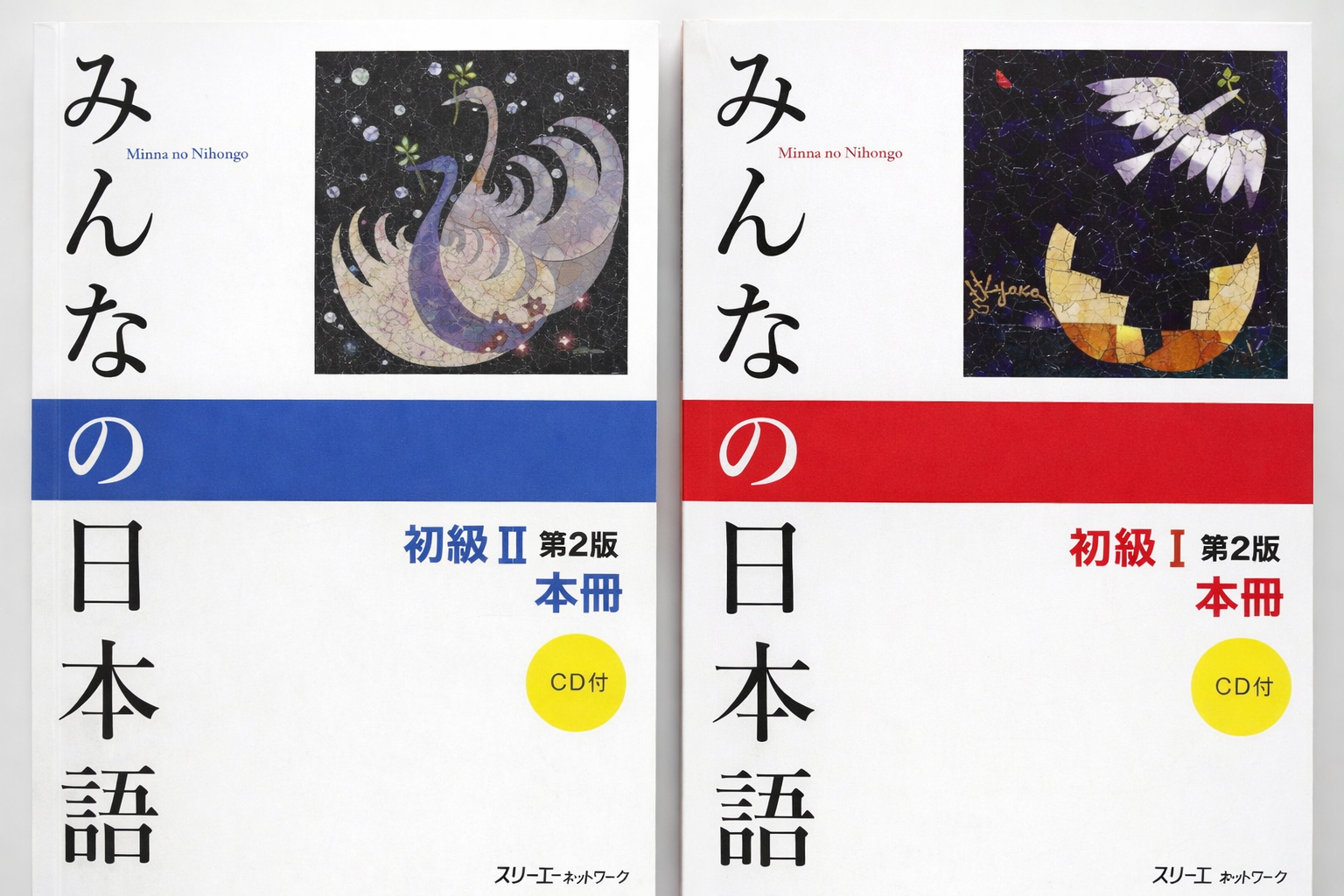
Step 2: Start Minna no Nihongo the Right Way
Once kana feels natural, move to Minna no Nihongo. You can buy the book on Amazon or find PDF versions online if needed.
Start with Lesson 1 vocabulary. Read it slowly. Then search on YouTube for “Minna no Nihongo Lesson 1 vocabulary” and listen to the pronunciation. After that, close everything and test yourself.
Ask yourself if you remember the meaning, if you can read it without romaji, and if you can say it out loud. Then open the book again and repeat.
This loop of book, video, and self-testing works extremely well.
Step 3: Grammar Without Fear
After vocabulary, move to the grammar of the same lesson.
Japanese grammar feels strange at first because it doesn’t follow English logic. Don’t try to translate word by word. Focus on understanding patterns.
Read the grammar, watch a YouTube explanation, then come back to the book and make your own sentences. Speak them out loud, even if they sound simple or broken.

Speaking early builds confidence
Step 4: Start Kanji Early and Slowly
Many learners delay kanji and regret it later. After finishing three lessons, start Kanji Lesson 1 from Minna no Nihongo.
Learn a few kanji daily. Write them. Learn the meaning and reading. Use them in words. Kanji becomes scary only when you avoid it.
JLPT Learning Progress
Think of Japanese learning as a long journey. Most people quit at the start. If you finish Minna no Nihongo (Lessons 1–50), you already cross a big milestone.
Finishing Minna no Nihongo takes you up to JLPT N4 (around 40% of the full JLPT journey)
The Role of Books (Yes, They Matter)
One thing I never skipped was structure.
I followed Minna no Nihongo seriously. Not halfway. Not selectively. Page by page. Lesson by lesson.

A single good book, studied properly, is better than ten unfinished resources.
Japanese rewards people who stay consistent, not those who rush.
What I Learned From This Journey
Over time, the results showed up JLPT scores, fluency, confidence. But more importantly, Japanese stopped feeling like a subject. It became part of how I think.
That’s the secret most people miss.
You don’t “study” Japanese forever. At some point, you live it.
And when you reach that stage, progress becomes natural.
If You’re Just Starting Out
If you’re beginning today, don’t ask:
“How fast can I learn Japanese?”
Ask:
“Can I fall in love with the process?”
If the answer is yes, you’ll be fine.
📩 Personal Consultation If you’re confused, stuck, or don’t know how to build a realistic learning plan you can consult with Nikhil Kun for:
- Beginner to JLPT guidance
- Self-study plans
- Japan life & language strategy
Final Thoughts 🌸
Japanese is not just a language. It’s discipline. It’s humility. It’s respect.
Learn it with the right mindset, and it will change not only how you speak but how you see the world.